Creativity and the unconscious illustrated

The structure of the unconscious illustrated.
As someone deeply interested in creativity and imagination, I’ve always been curious about what the depths of our minds could look like. I also happen to be one of those people obsessed with the sea. I’m an ocean-paddling enthusiast and the days spent on the water inspired me to make a visual metaphor of the unconscious and it’s relationship to artistic creativity.
I hope that others interested in creativity might find this model helpful and insighful in understanding their own creativity from a psychological stand point. It is worth bearing in mind though, not to take metaphors literally. While they do help to illuminate, they can also distort, because no single image could ever capture the psyche entirely.
Why metaphors matter?
An illustration as a metaphor can go a long way toward making complicated ideas intuitive. For this visualization, I decided to depict the psyche as a vertical, transparent slice of ocean. I am a visual person and, in addition to being a photographer, work as a graphic designer as well, so I really get a kick out of thinking visually and fleshing out ideas this way, as opposed to a simple stick figure diagram.
To my pleasant surprise, I discovered that several well-known psychologists (Jung, Neumann, Bion, Porges, Bollas, Hillman) have used similar analogies. Comparing mine with theirs helped validate the approach. For clarity, I should point out that I’m not a psychologist, just a photographer with a fascination for psychology, especially the work of Carl Jung, who has shaped my way of thinking more than anyone else in the field.
The stucture of the unconscious
We cannot look at the human mind directly, so an analogy helps to visualize it. The ocean turns out to be a surprisingly accurate representation of the psyche’s different components and how they interact.
The basic structure is fairly straight forward and goes like this:
Above the surface = consciousness
Below the surface = the unconscious
The conscious mind (also known as the ego, or waking awareness, in jungian psychology) can be imagined as the world above the waterline. It’s where you would find yourself if you were sitting in a kayak or a rowing boat, going about your day, steering and making decisions. In Jung’s terms, the ego floats on the ocean.
Importantly, consciousness doesn’t only expand upward into the open air. With effort and attention, it can also extend downward into the water.
The surface as a shifting threshold (the interesting bit)
The surface of the ocean acts as a living threshold between the conscious and unconscious. Like actual water, it's never perfectly flat or still. It’s a dynamic, wavy zone where small bits from below can rise upward. While we sit just above the waterline, mostly at the conscious state, the ebb and flow of the surface causes unconscious material the reach the level of our awareness, and I think that is the interesting bit, that most models of the psyche fails to visualize in a manner that can be understoot intuitively. In these simplified pie-chart models, the threshold is usually depicted as a straight line, a distinct hard edge that separates the consciouss mind from the unconscious, even though, quite clearly, in reality it is more like a wavy zone.
I think this is intersting because, as mentioned, unconscious material often breaks through in small fragments that are experienced in sudden ideas, intuitions, visions, snippets of dream imagery or moments of active imagination. This model should help to understand where the ideas are popping out from and what the mechanism is like.
The ideas, visions etc. appear like waves, splashes, bubbles or droplets. They are like fleeting contacts with the depths. They are fuel for creativity. Many creatives know the sensation of their art pouring through them. In the so-called flow state, it can feel as if the artwork gives birth to itself, using the artist as a tool.
Unconscious material doesn’t cross the threshold fully formed but it must pass through the surface, where it breaks apart or becomes partially visible. This aligns not only with Jung’s idea of the threshold of consciousness but also with cognitive science’s view of access consciousness.
And just as the sea has many kinds of surfaces: calm, turbulent, tidal, the mind has multiple thresholds: sensation, emotion, symbolic imagination, conceptual meaning and reflective awareness all behave like shifting layers of surf.
Conscious contents move across this membrane as well, but in the opposite direction. That is to say, unconscious material does not only rise upwards, but conscious material also tends to sink downwards, like dropping something from the boat into the sea. Repression, forgetting, habituation and background processing all involve material sinking downward into the depths, but the downward movement isn’t necessarily the bit that we’re interested as creatives, but instead the realisation that there is a such a huge reserve, a freaking stockpile of unconscious content for us to use in our art, sitting just below the threshold of our awareness. I think it is helpful to be mindful of it and to know, that it can be accessed to elevate our creativity. After all, creativity is nothing without ideas and good ideas are like these droplets that sometimes just pop into our heads.
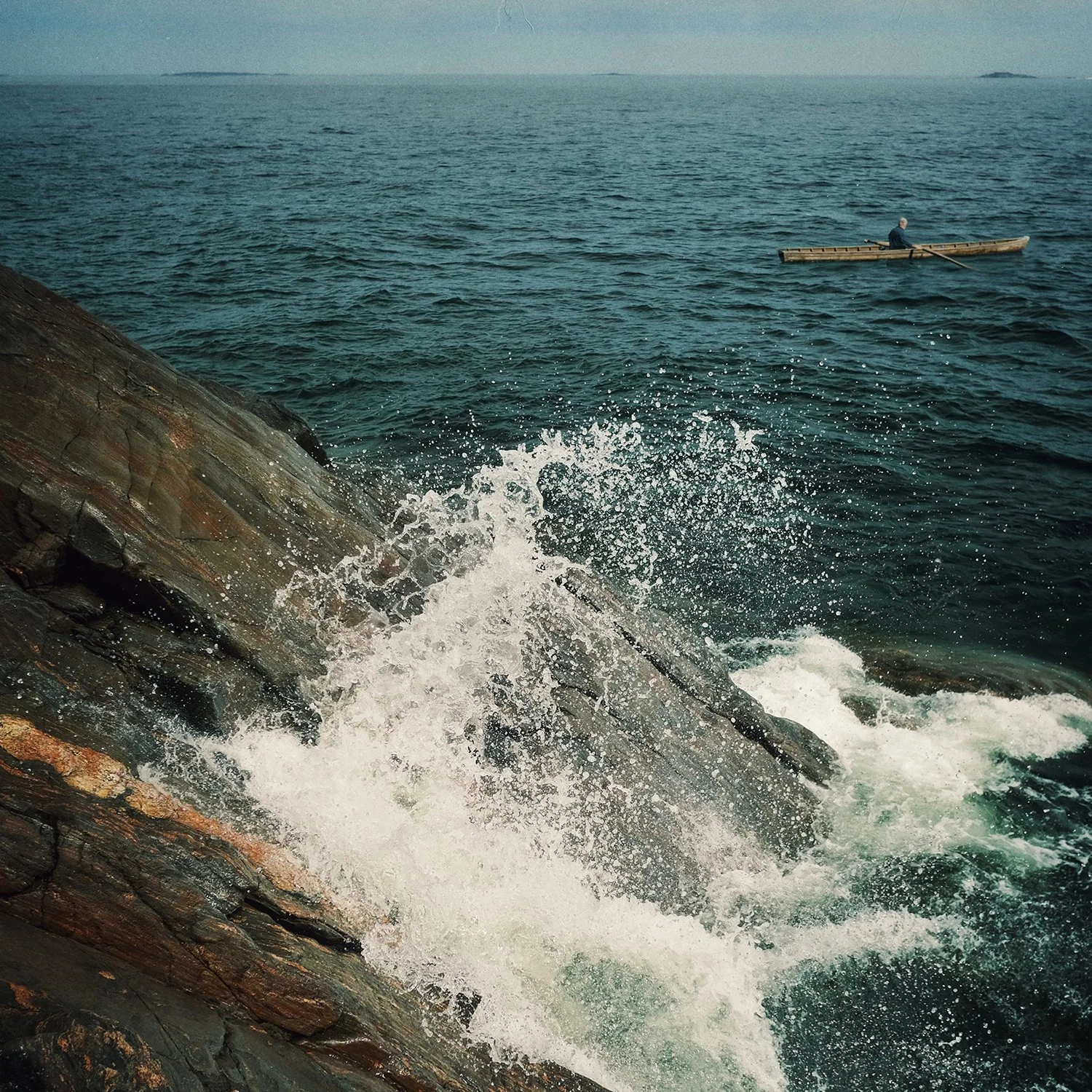
On this view, you can see how the droplets and splashes, symbolising unconscious material, momentarely rises high up and beyond the waterlevel, breaking the threshold of consciousness and reaching the height where the person in the boat is sitting.
Accessing the unconscious material with meditation, active Imagination and dreams
Meditation, in many spiritual, religious and psychological traditions, is described as calming the waters. When the surface settles, we become able to see slightly deeper, still from above, still conscious, but with glimpses of the shapes and silhouettes below.
You can even hear David Lynch using similar language, when he talks about transcendental meditation, stating that there is “an ocean of consciousness” out there, referring to the unconscious as a reservoir of information, that can be accessed via meditation.
David Lynch quite often also talked about catching individual ideas from a current and my interpretation is that, while having different vocabulary, he is referring to those droplets of unconscious material.
This is also close to what Carl Jung meant by active imagination: remaining awake and aware, but allowing unconscious contents to rise and take on forms that can be observed, almost like watching short scenes or dreamlike images as unfolding video clips.
Sleep, by contrast, is a slipping beneath the surface entirely. It’s a state where the threshold becomes more permeable, letting deeper material drift upward, often veiled in symbolic imagery. In lucid dreaming, ego and unconscious temporarily co-exist below the surface.
Active imagination and meditation goes hand in hand as active imagination can typically be experienced in meditative states. And even though not quite accurate, I really like the idea of taking a swim or snorkling, as a metaphor for meditative states. In that state you’re not only looking down from the boat through the surface into the depths, but literally lowering yourself into the surface level or directly into the water. There’s just something deeply (pun intended) fascinating about the idea of submerging… literally merging into the sea. That, how ever, tends to imply losing awereness, but then again… I’m not a very good meditator and often tend to slip into a nice little nap while doing it.
Using David Lynch once more as a case study, I remember him describing the origin story of his 2001 movie Mulholland Drive, which was originally planned as a spin-off TV-series of Twin Peaks. The production eventually faced a dead-end (financial backlash, if memory serves) and was forced to take a different shape as a movie, even though the pilot episode was already being filmed. Having to modify the entire concept, Lynch faced a huge creative puzzle: what to do with the filmed material and how to turn that into a completely different story while squeezing it into a single movie? A nightmare situation no-doubt, having to change plans so dramatically right in the middle of the production. Lynch said in an interview, that a new vision and plot structure came to him while he went to meditate upon the matter. After that, he had a crystal clear plan for the movie, which turned out to be nothing less but a masterpiece. If you haven’t seen it, I highly recommend it, as it strongly supports the story with its unbelievable dreamlike imagery.
The different levels of the unconscious depths
Beneath the surface, the mind opens into a vast underwater world with its own currents and tides. The shallower layers represent the personal unconscious, including forgotten memories, repressed material, habitual patterns, old emotions and the psychological complexes that act like underwater currents.
The deeper layers represent the collective unconscious, home of the universal psychological archetypes.
Psychological archetypes
Archetypes are not simple images or characters, but deep structural patterns and the embodied tendencies of human nature. In this mode of thinking, they aren’t fish or crustaceans so much as woven in to the fabric of the sea itself. In a way, they are the sea, or at least an integral component of it. I chose to depict them as submerged statues or mythic figures. They feel more like ocean spirits than marine animals, ancient forms shaped by currents older than any individual life.
These archetypal patterns lie far from the surface and seldom rise directly. They are more often sensed than seen, felt as moods, symbols, intuitions, figures in dreams or visions. On rare occasions, if you are lucky, they can be encountered and interacted with, when they surface dramatically in personalised forms during moments of creativity, crisis or transformation.
If you’re having a hard time understanding what a psychological archetype is, that makes two of us. The discourse surrounding archetypes is quite often veiled in mysticism, which can sometimes paint a wrong kind of picture. I’ll be honest, I’m heavily intrigued by mystical thinking as well and I need to make a conscious effort of not sounding like drunken Gandalf when I get carried away with writing. So with that being said, I’ll now try to give a grounded description of archetypes.
Ahem… *Clearing throat*
In Jungian psychology, an archetype is a deep structural pattern, a universal psychological tendency and a behavioral blueprint, not an image, character or a thing, but a form that shapes experiences. They are closer to root patterns, instinctual tendencies and organizing principles, but not personalities, even though they can show up as characters.
Even though they are abstract patterns, the psyche gives them imagery so we can interact with them. In dreams, visions, active imagination or even hypnopompia, the psyche personifies these patterns. This is why the Shadow may appear as a dark figure, the Anima as a woman, the Wise Old Man as a mentor or the Self as a deity, jewel, mandala or oceanic presence. This is not the archetype itself, it is the psyche’s way of giving form to something that cannot be seen directly. They can appear as personalised characters that can even introduce themselves by names. They can speak, have behaviour, show traits or moods and indeed, form relationships with the dreamer.
So archetypes manifest as personalized characters, but they are not characters themselves. I wish they would be more mystical than that, but hey… reality is kind of boring like that.
Jungian framework of archetypes is wrapped around poetic and symbolic language, that has grounding in antropology, but it is not pseudo-science. Modern studies, such as evolutionary psychology talks about inate cognitive templates, which is a more clinical viewpoint, claiming that archetypes are evolution-shaped biases in perception and behavior. In this view, archetypes are evolved mental programs or behavioral predispositions shared by all humans. Similar idea but without symbolism or myticism. Universal neural circuits and behavioral patterns inherited from human evolution. It is testable and grounded in biology, but loses symbolic richness.
Other psychological fields have their corresponding concepts too: cognitive neuroscience talks about predictive brain priors, clinical psychology has a concept of deep schemas etc. but as far I know, they do not involve hooded figures chanting or casting ritual spells.
Real life encounters with archetypal figures and the questions that prompted to figure all this out
One major catalyst for writing this essay was an encounter with an archetypal figure, just recently. It wasn’t the first time though. Few years ago I had a text-book Shadow archetype appearing in multiple dreams. The Shadow had a name, a distinct personality and I was able to communite with it. It was a freakishly intersting experience. Afterwards, I always though it would be interesting to encounter some another personalised archetypes as well.
I had to wait few years, but couple of weeks ago, a clear Anima figure emerged unexpectedly, while I was preparing to do a meditation session of sorts. She too was clear as a day and was able to communicate, state her name etc. If you have not experienced something like this, it might all sound mentally ill, but there is no pathology involved. They just happen to be normal psychological experiences, just like dreams. These encounters are internal dialogues, not external entities.
The Anima encounter prompted some hard questions along the lines of: where do these figures come from? Is there some remote corner in the back of my head where these things live and if so, what does it look like? The experience really inspired me go in to the woods and sit on a rock for a while in an attempt to understand all this better.
Prior to fleshing out the ocean theme, I started to make some sketches of how I understood the mechanism. My initial attempts resembled more like the workings of a lava lamp, where the gooey stuff rises and sinks inside the lamp. I eventually abandoned the lava lamp idea as it slowly evolved into a nice little ocean scene.
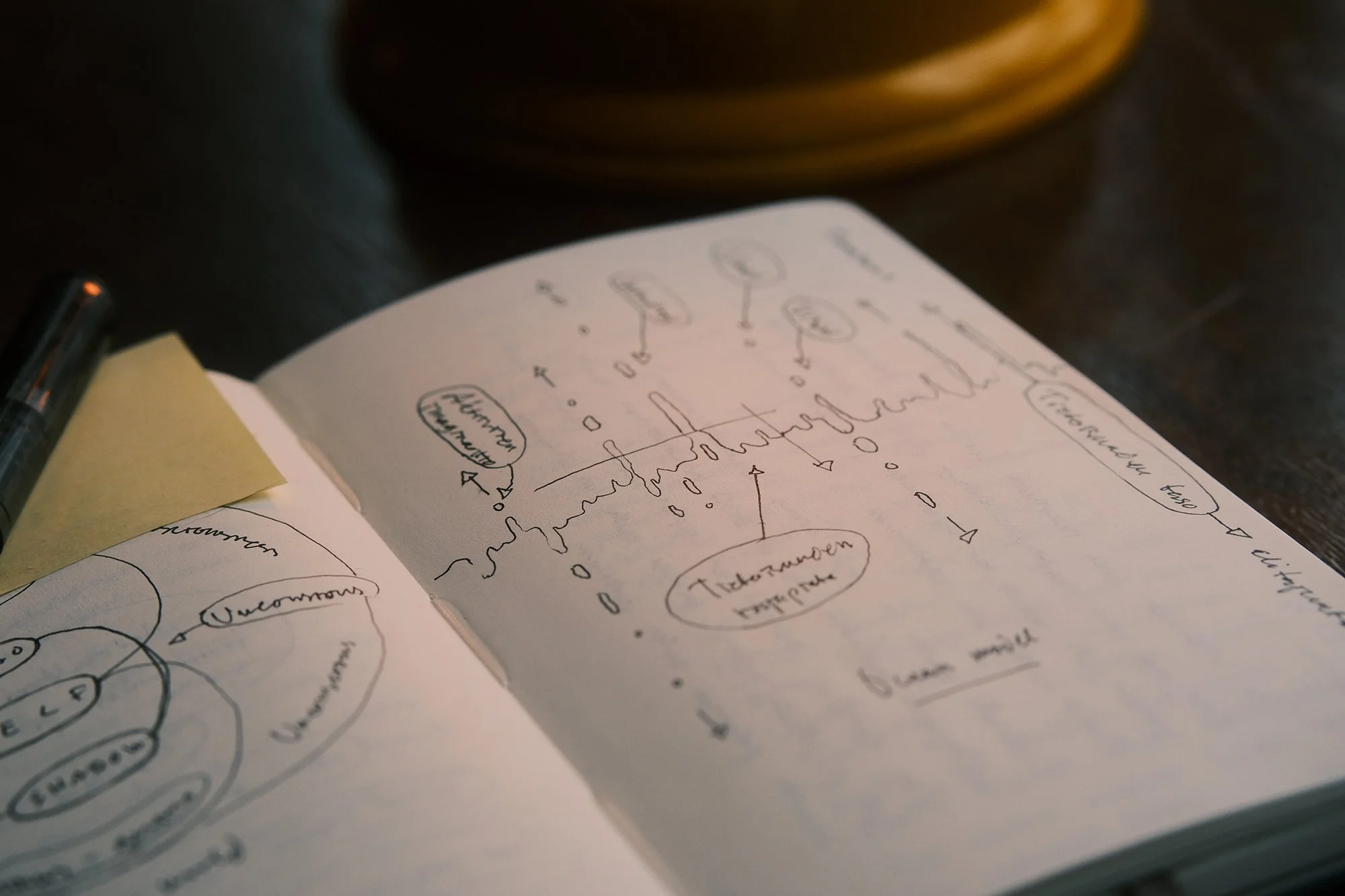
An early draft sketched on my notebook.
Extending the metaphor
Of course, the ocean of the psyche is not a neatly isolated cube and I’m tempted to refine it even more, so maybe I’ll update the text with some additional notes in the future. I think the strength of the model is it’s flexibility. For example, extending the model horizontally could allow it to represent many other psychological features too.
Here are some ideas, that I think the ocean model could depict on a guite intuitive level:
Storms: trauma, emotional overwhelm and upheaval
Shorelines: society, relationships and cultural influences (inner world = the ocean, outer world = the land)
Coral reefs: habitual patterns and long-formed behaviors
Deep trenches: repressed, archaic or forgotten material
Currents: complexes that pull or push our behavior
Murky waters: emotional overwhelm, depression, confusion
Mist & fog: dissociation, depersonalization, derealization, loss of embodied awareness
Psychosis: boat capsized and the person and the surface of the water no longer functioning as a boundary, unconscious material rising unchecked (symbols may be interpreted literally and inner figures appear as external entities.)
Schizophrenia: boat capsize and the person not able to re-enter the boat or find footing in the surface, causing an unstable sense of reality. The person is basically drowning in a violently unstabe weather conditions and whirpooling waters, representing intrusive unconscious material like voices, delusions and archetypal eruptions.
And so forth…
This is a topic that I’m extremely interested of. The ocean is a flexible and living metaphor, capable of expanding in any direction needed to understand the psyche more clearly.
Thank you very much for reading!